






Veritasium spotlights the Edgerton Center
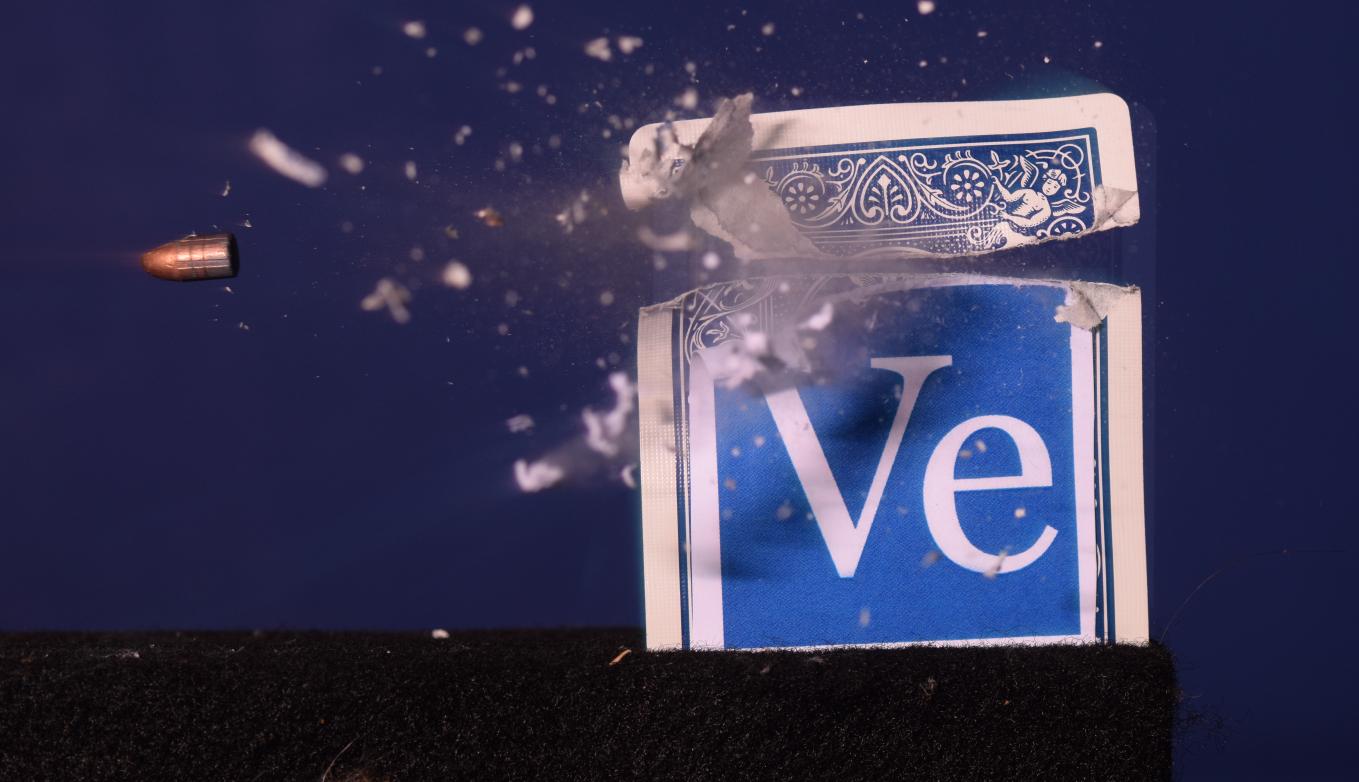
“Lights!” called Dr. James Bales, Associate Director of the MIT Edgerton Center, and the Strobe Lab went dark. A few moments and several safety commands later, a shotgun rang out. A high-powered strobe light flashed for half-a-millionth of a second, leaving all the eyeballs and camera lenses in the room imprinted with an image that seemed to freeze time: a bullet suspended mid-air, ripping through a carefully positioned playing card.
Of course, high-speed strobe photography of bullets mid-flight happens all the time at the Edgerton Center, which was established in 1991 to honor the legacy of the pioneering photographer and researcher Professor Harold “Doc” Edgerton. This instance was special. The playing card in question was emblazoned with the logo of the wildly popular science YouTube channel, Veritasium, and all of this was filmed for a feature on their channel. Since its release in mid-January, the video has been viewed nearly 7 million times.
Veritasium began posting to YouTube in 2011 and has since garnered more than 3.7 billion views and amassed a following of 19.5 million subscribers. Their videos typically involve an in-depth examination of a scientific idea or theme, and combine expert interviews, demonstrations, and engaging animations to bring the topic to life.
In their latest video, Veritasium shifts the spotlight from the bullet and playing card to Doc Edgerton himself. Through their exploration of slowing down time through strobe photography and slow motion, they uncovered the stories and techniques behind some of his most iconic photographs. Guided by the expertise of Prof. J. Kim Vandiver, Forbes Director of the Edgerton Center, and Dr. Bales, the team also replicated several of Edgerton’s notable experiments using a mix of contemporary and Edgerton-era equipment.
The channel’s creative team includes Leah Sullivan “Sulli” Yost ’22. Now a writer-director at Veritasium, Yost took the Strobe Lab class taught by Dr. Bales during her senior year at MIT as part of her dual major in math and writing. When another writer pitched the idea of covering the Edgerton Center in an upcoming video, Yost recalled “right away I dropped photos in the chat!” She still had her own photographs of bullets blasting through chalk, multi-flash exposures, and her group-designed project examining the Leidenfrost effect right on her desktop. “Dr. Bales always had good stories,” she reminisced with a smile, going on to predict that these would be great for the video.
During their October visit to MIT, the Veritasium team (which consisted of host Gregor Čavlović and videographer Michael Cimpher) spent several days at the Edgerton Center taking a crash-course version of Dr. Bales’ Strobe Lab class, recreating some of Edgerton’s most iconic photographs and examining the setups and scientific principles behind them. This included several variations on bullet photos, a corona of milk suspended mid-air, and balloons captured mid-pop. Crucial to all these methods are the way in which the photographer triggers the camera and strobe, which the video explores in depth.
After demonstrating and demystifying photographic techniques that still inspire awe a century after their invention, Dr. Bales and Prof. Vandivier sat for interviews in Edgerton’s former electronics workshop. (The space is now home to a beloved Makerspace called the Student Project Lab.) The interviews ranged in subject matter from fascinating technical explanations of triggering mechanisms to charming personal anecdotes about Edgerton and the history of the Edgerton Center. Beyond his scientific aptitude and incredible eye for photography, Edgerton was an early believer in hands-on experiential learning. He was known as someone who “gave of himself, his time, and his resources to support the work of other people,” reminisced Vandiver, who was a Teaching Assistant to Edgerton in 1972. “If you want a true celebration of the legacy of Doc, you need to take space to honor those traditions.” Referring to a nearby photograph of Edgerton strumming a guitar in a party hat and surrounded by smiling students, Vandiver recalled “MIT is a hard place for students – and he made it fun.”
As part of their investigation into high speed photography, the Veritasium team also visited the Camera Culture group at the Media Lab. Second-year graduate student Nikhil Behari, whose research involves image capture in the neighborhood of one trillion frames per second, connected the dots between Edgerton’s work in the 20th century and the cutting-edge research taking place at MIT today. “We all want to be able to see so much more than what the human eye averages over, and look at what’s actually happening,” he said. “The question is: how do you time the returns of light so accurately? That’s what’s always been worked on.”
The space at the Media Lab where Camera Culture captured light in flight has some surprising similarities to the Strobe Lab where high-speed photography took root at MIT. While, indeed, this lab features specialized equipment like a high-powered laser and advanced neural network-enabled processors, tools that would’ve been familiar to Edgerton are also present. Timers, mirrors, and stopwatches have retained their value even as high-speed photography has progressed from the micro-second to pico-second scale. Also present in both spaces is a deep sense of curiosity, interest in the work of others, and prevailing good humor.
But wait – how did Edgerton manage to freeze time with his pioneering strobe photography? Find out now from Veritasium.
High-speed photography credit: Dr. James W. Bales