


No application required

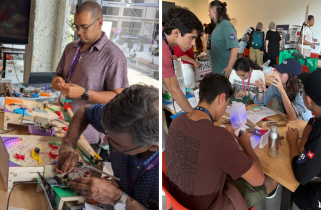
They were here for The Saturday Thing: the open-door program Moriarty has hosted since 2002, where young people bring their own ideas to life, designing and building self-directed engineering projects alongside MIT students and alums. There is no application, no tuition and no prerequisites. Students show up and build the thing they want to build. It’s as welcoming as outreach can be. The only requirement is enthusiasm.
“Bob Karash, a Bell Labs veteran and longtime Saturday Thing mentor, describes the atmosphere as ‘unfettered research’ — not so different from the curiosity-driven research that [MIT] President Kornbluth emphasizes as essential to discovery,” says Moriarty.
The teenagers could not have known that one spontaneous visit would turn MIT from a school Zhang had never considered into the place where both would earn multiple degrees and pursue their doctoral work.
Getting to the Saturday Thing: A journey across the river
Their journey to the Saturday Thing started at Northeastern University with a quest for a free Arduino microcontroller.
Zhang and Liang were stuck on Northeastern’s campus, left behind when the rest of their summer program went on a field trip, and Zhang had an idea. He emailed an electrical engineering professor who had spoken to the group about the budding maker movement asking, essentially, hey, man, can I have one of those Arduinos you were talking about?
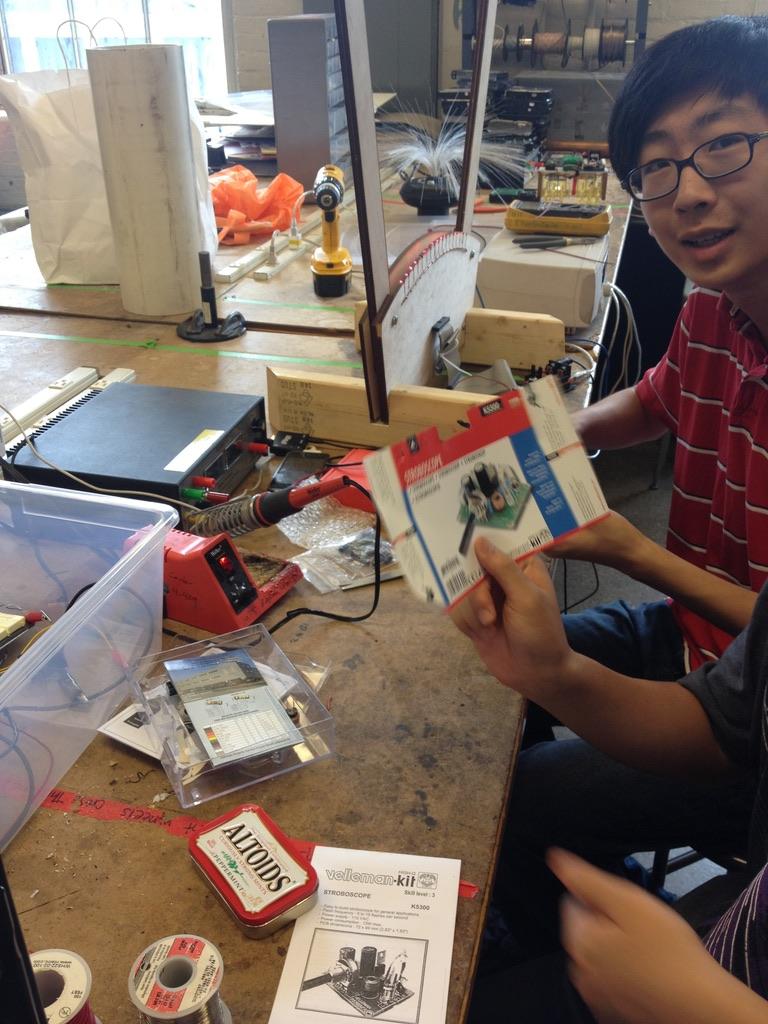
The reply came back quickly: Yes, come on over. Despite bad knees and a doctor’s order to avoid climbing stairs, the professor led him up six flights to the Radio Society. There, he found a spare Arduino and a boxed kit for building a stroboscope, handed them to Zhang, and sat down to rest.
Back at ground level, Zhang showed Liang the kit, and Liang was inspired. “We should go over to the Edgerton Center with this,” Zhang remembers him saying. “That guy practically invented these!”
And across the river they went.
Discovering magic at MIT
At the makerspace, shop mentors Karash and John McGoldrick ‘73 got the pair up to speed on the jigsaw, soldering and the friendly ribbing most shop visitors receive from Moriarty.
“The whole kit took probably an hour, max, and it was my first time soldering something,” Zhang recalls. “There was something magical about it, which I think Doc [Edgerton] really understood.”
Magical is a word that comes up often as Zhang recounts that day, and his years at MIT since.
Before that Saturday, MIT was not on Zhang’s radar. He already had an interest in programming and was part of the FIRST Robotics team at his high school nearby in Boston. Still, he had not considered it. “Coming here completely changed my mind,” he reflects. “I think it was really meeting people and seeing what the people were like. I met people at other universities, too, but they didn't strike me as so interesting.”
The first project wrapped up within the day. Zhang came back the next week anyway. “It just seemed like a fun place to be,” he says.
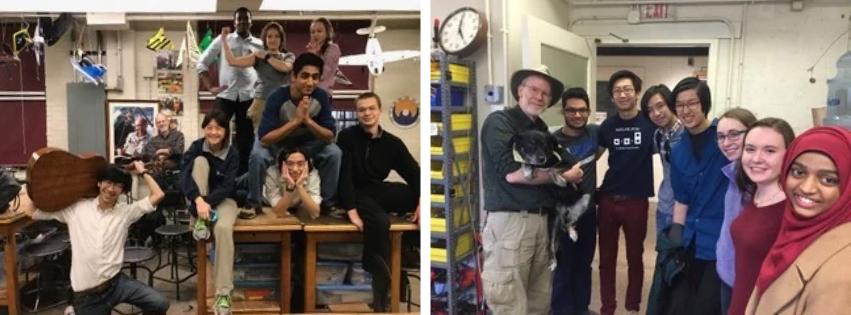
That is the heart of Moriarty’s approach, in the spirit of Doc Edgerton before him. Edgerton’s well-known credo: “Work like hell, tell everyone everything you know, close a deal with a handshake, and have fun.”
“I deliberately avoided calling it something like ‘Science Saturday’ or ‘Engineering Fun.’ Those are adult labels that impose an agenda,” Moriarty explains. “I wanted The Saturday Thing to be a place where nobody tells you what you’re supposed to be interested in, where there’s room for serendipity. The secret sauce is unstructured play in a supportive environment — the freedom to explore, experiment, fail, collaborate, and follow your curiosity wherever it leads.”
This approach has earned Moriarty formal recognition from the Institute. In 2022 he received both the Gordon Y. Billard Award, given for special service of outstanding merit to the Institute, and the Excellence in Mentorship Award from MIT's Office of the First Year. “He goes far beyond teaching STEM,” said then-President Rafael Reif. “He inspires creativity, wonder and joy.”
Paying it forward
Zhang graduated from Boston Latin School in 2015 and came to MIT. He kept returning to the same makerspace he’d discovered that Saturday, first as a casual user, then, beginning on Halloween 2019, as a student shop mentor. “See, there’s a picture of me on the wall over there — I’m in costume,” he laughs.
If you ask him why he became a shop mentor, he’ll tell you about the kind professor with the bad knees at Northeastern. “That's why I feel so strongly about helping somebody, even just a little bit,” he says. “If he could do that with his knees, I can do anything to help somebody. That was pretty above and beyond for a student he'd met once.”
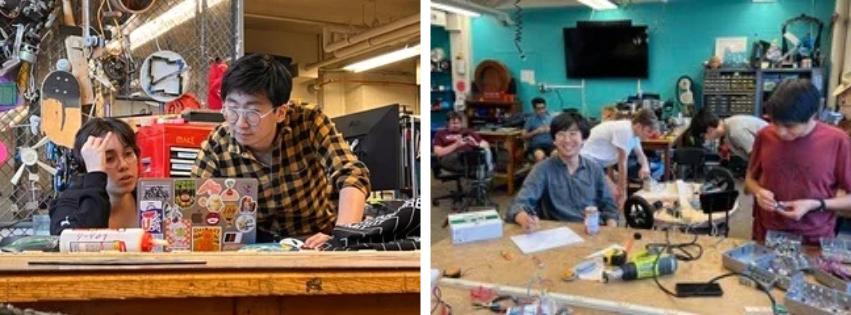
The center of his own Venn diagram
Zhang stayed at MIT for his master’s degree, then completed a PhD that he admits is hard to summarize. Half of his doctoral work dealt with a tiny microphone, implantable in a human ear, that could help hearing-assistive devices like cochlear implants vanish inside the body. The other half was an enormous umbrella reflector for satellites.
“It seems so different, but what ties the projects together is the theory, the analysis, and the implementation,” he explains. “It’s all electromechanical things, right? It’s electrons doing stuff to make things move or sense things.” Then, with a chuckle: “I’ve started telling people, the biggest commonality is that I work on both of them.”
Thirteen years after first walking into the Edgerton Center, Zhang can be found right up the hall. He’s still thinking about electricity and signals, now as a postdoctoral researcher with the Department of Materials Science and Engineering. His office is just a few doors down from the 4-409 Student Project Lab.
Asked what he values most about his time at the Institute, Zhang doesn’t mention the degrees. “I’m happy to be here, and I’m glad I’ve met all the people,” he reflects. “That’s the best part of MIT.”
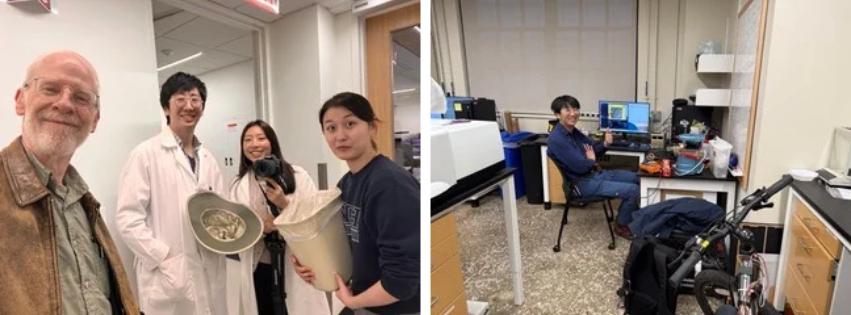
The door stays open
Zhang still drops by 4-409 to see what undergraduates are building, help solve problems on the whiteboard and share stories from his decade-plus at the Institute. Inspired by Edgerton and Moriarty, he’s now in the habit of snapping photos to capture the magic of daily life. And yes, he still has the little stroboscope in a box from that Saturday in 2013.
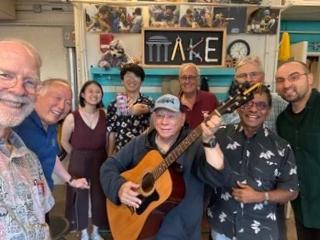
The box is a lasting memento from a Saturday that had no barrier to entry. No one screened him before he walked in. No one checked his transcript, what he knew about strobes, or whether he could solder. The Edgerton Center offered a 15-year-old a Saturday, some tools, a couple of mentors, and a lens through which Zhang could reimagine his future.
“John’s journey illustrates what can happen when we give young people the freedom, resources, and encouragement to discover possibilities they never imagined,” Moriarty says.
The Saturday Thing has run nearly every week since 2002. Somewhere in this Saturday's crowd is a 15-year-old who doesn't know yet that MIT is an option.
But they will soon.
Photo and video courtesy of John Zhang, Ed Moriarty, and MIT School of Engineering