


Edgerton Center hosts inclusive hackathon to kick off summer of hands-on learning
Accessibility that benefits everyone
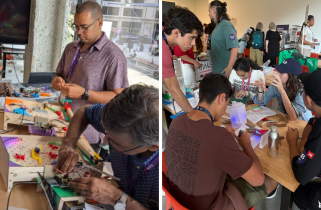
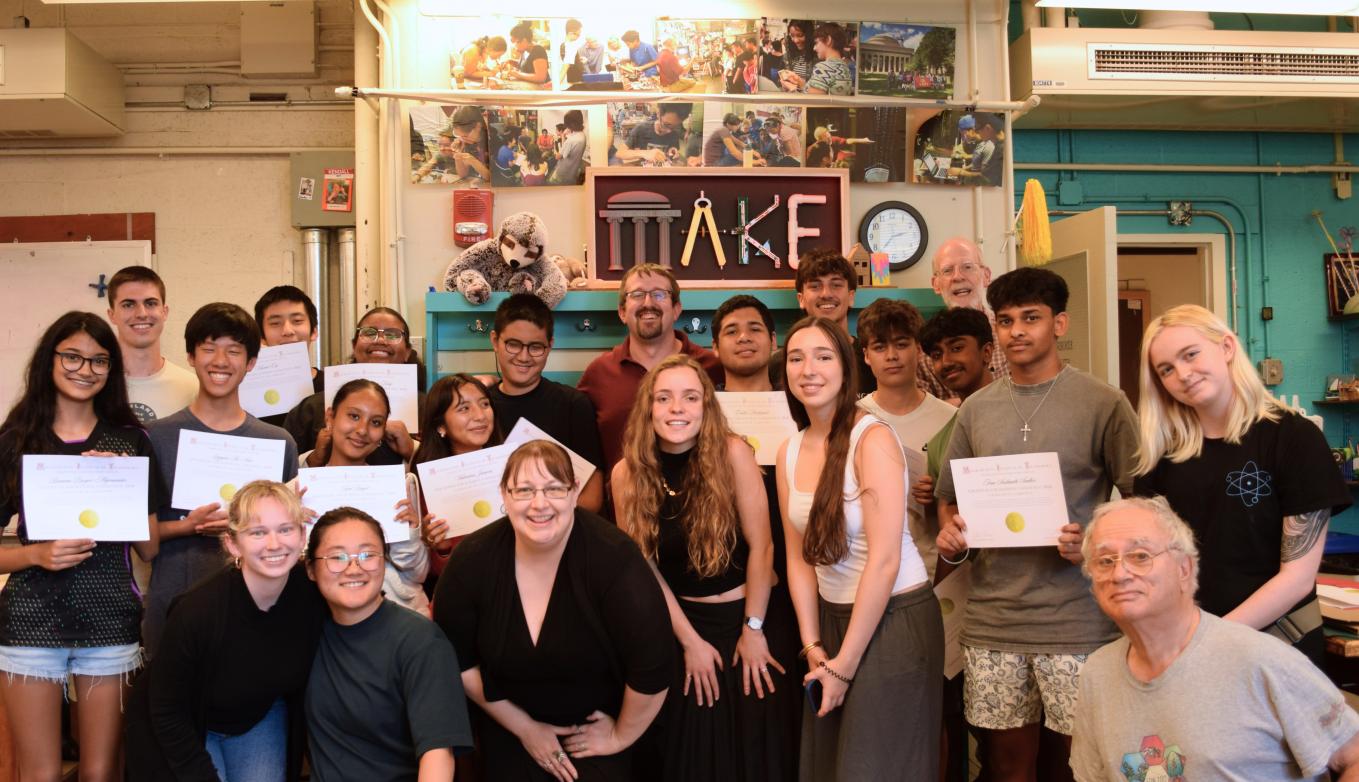
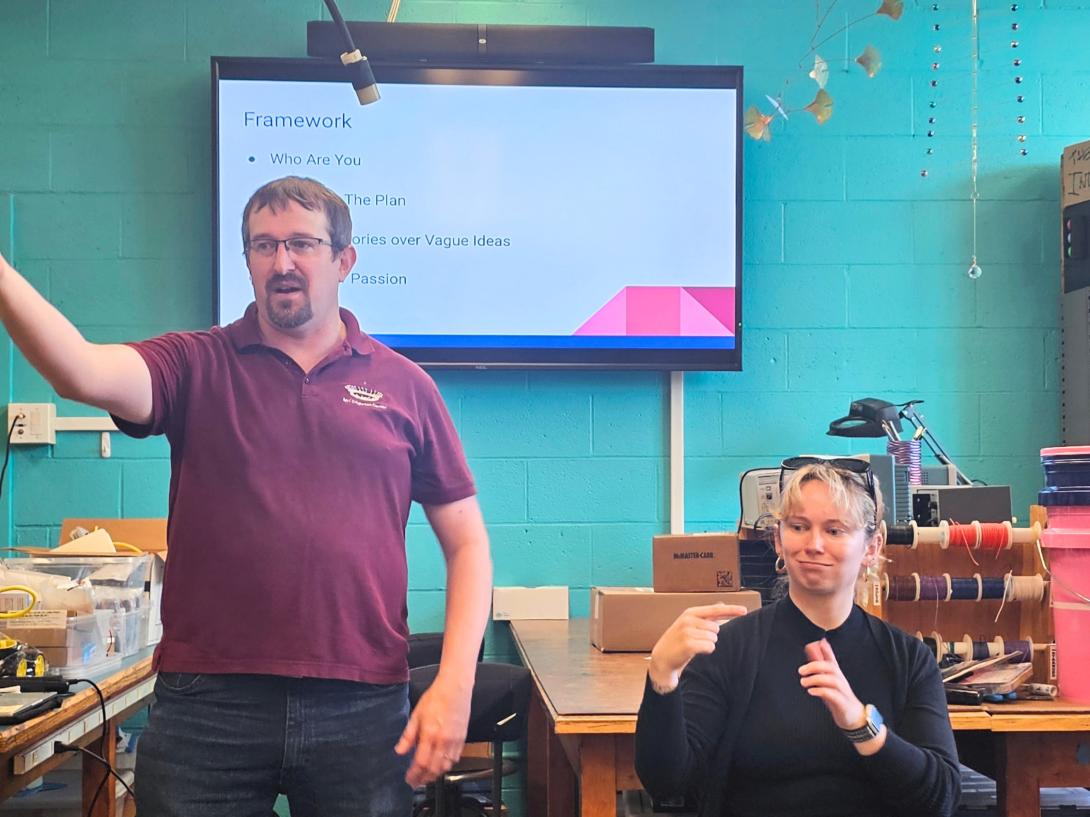
The hackathon brought together 12 students from around the world, including Lucy and Carlos, who are Deaf, as well as Harry, who is blind. Their presence pushed the team at MIT to think more carefully about how activities were designed, and the results delighted everyone.
An introductory activity asked students to do "five-second drawings," passing work quickly around the room to complete collaborative sketches. To better include Harry, the team adapted it: instead of drawings, students had 15 seconds to create small sculptures out of clay. The change worked so well that mentors brought it back the following week, even when no blind students were present. What was implemented as an accommodation had become everyone's favorite version of the activity.
It's a pattern Amanda Gruhl Mayer ‘99 PhD ‘08 had come to expect. Adjustments made for one student have a way of improving the experience for the whole room.
Two years of building confidence
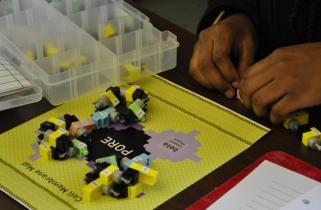
Gruhl Mayer founded STEAMED two years ago to expand access to meaningful hands-on learning opportunities. Over its two cycles, the program helped students build the foundational maker skills needed to succeed in their project builds, and helped Gruhl Mayer gain insights into supporting students of all abilities in hands-on learning environments.
One of Gruhl Mayer’s central takeaways was that inclusion does not require a fundamental overhaul of how STEM is taught. "Really, there aren't many changes needed,” she explained, "it's mostly a language barrier. Deaf students have a visual language instead of an auditory one."
The Edgerton Hackathon Challenge classroom, populated by students from across the US and mentors from around the globe, overcame linguistic barriers naturally. With students and mentors communicating in ASL, Turkish, Italian, Spanish, Catalan, and more, the room was a multilingual, multicultural environment, where different forms of communication were just part of how things worked. For Professor J. Kim Vandiver, Forbes Director of the Edgerton Center, this illustrated something unique about the Edgerton Center. “It really was a special moment; it’s unusual to see that kind of community interaction going on.”
The projects: Ten hours to prototype
With only about 10 hours of build time and no predetermined concepts, students were challenged to brainstorm original ideas and see them through to a working prototype. The resulting projects tackled real-world issues with empathy, creativity, and innovation.
Team Lecture: AI-powered study tools
One group tackled a challenge familiar to students everywhere: the long lecture. Their app, developed under the name Team Lecture, condenses educational content into manageable study materials through live transcription, audio and video file uploads, and a chatbot that allows users to ask specific questions about the material. The platform also generates practice problems, multiple-choice quizzes, and flashcards. Future iterations would integrate with a custom, Kindle-like hardware device designed to minimize distractions.
During the Q&A, the team was quick to clarify what their tool is, and isn't. The product is meant to supplement, not replace, human teachers. “Interacting with human beings is much better, in most cases, to a robot-human interaction,” they stated with certainty. Its generated study materials would be grounded in the instructor's own words from lectures. The team envisions eventually building out the platform into a standalone app that functions alongside their hardware.
Team "Mist Me": Wearable cooling technology
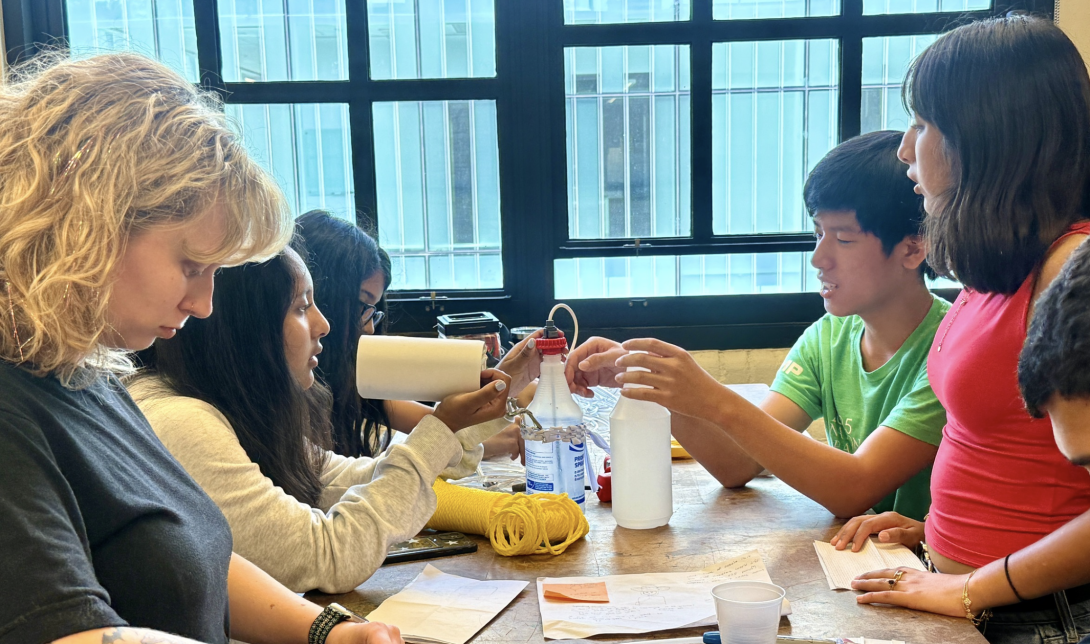
The inspiration for Team "Mist Me" was personal. One student's father works as a roofer in Texas, where heat is a daily occupational hazard. The team's solution was a cooling hat equipped with water atomizers designed to provide relief in extreme outdoor conditions.
“Our goal was to make this hat portable, comfortable, and lightweight enough for your head, so the person who maybe is an athlete, or a hiker, or maybe just, like, a blue-collar worker like my dad, to be able to enjoy this hat while doing their activities outside,” team member Valentina noted.
The build was anything but smooth. The team cycled through broken water pumps and tubing that wouldn't cooperate. They also discovered a significant design flaw: the initial sprayer placement obstructed the wearer's vision. After rethinking the configuration, this time with glasses-wearers in mind, they repositioned the atomizers to enhance sightlines for the wearer.
Team AIR: Designing for independence
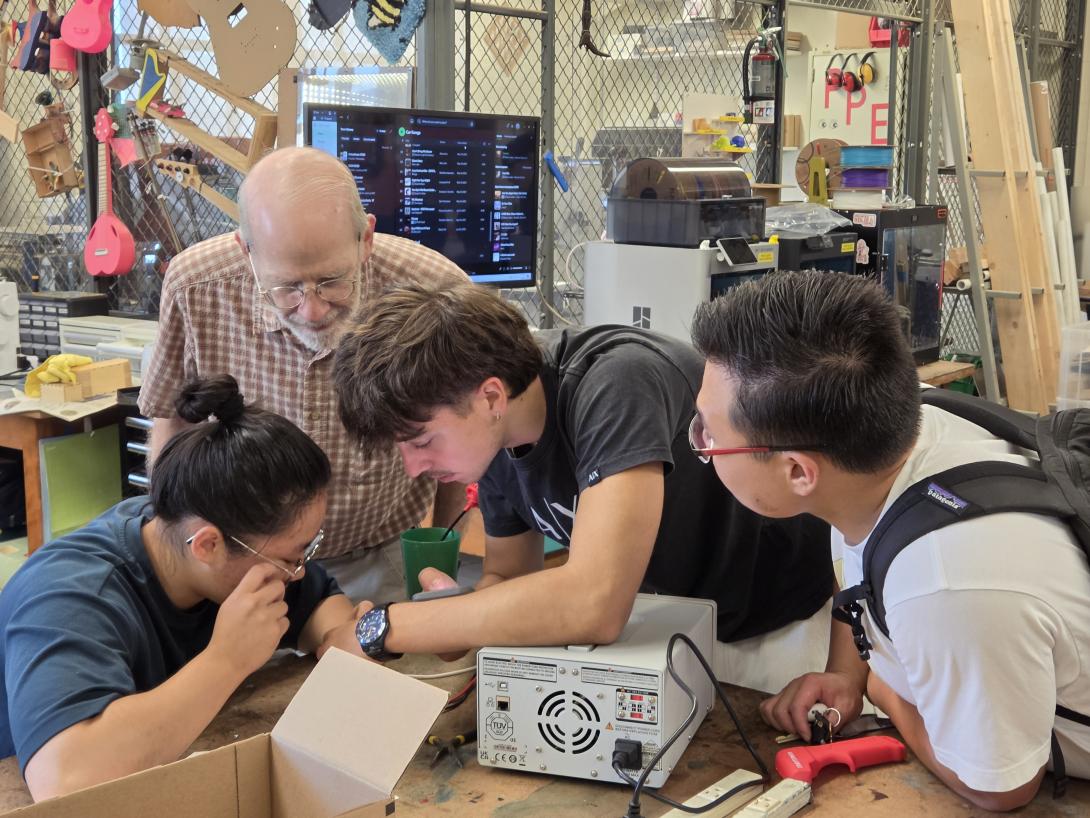
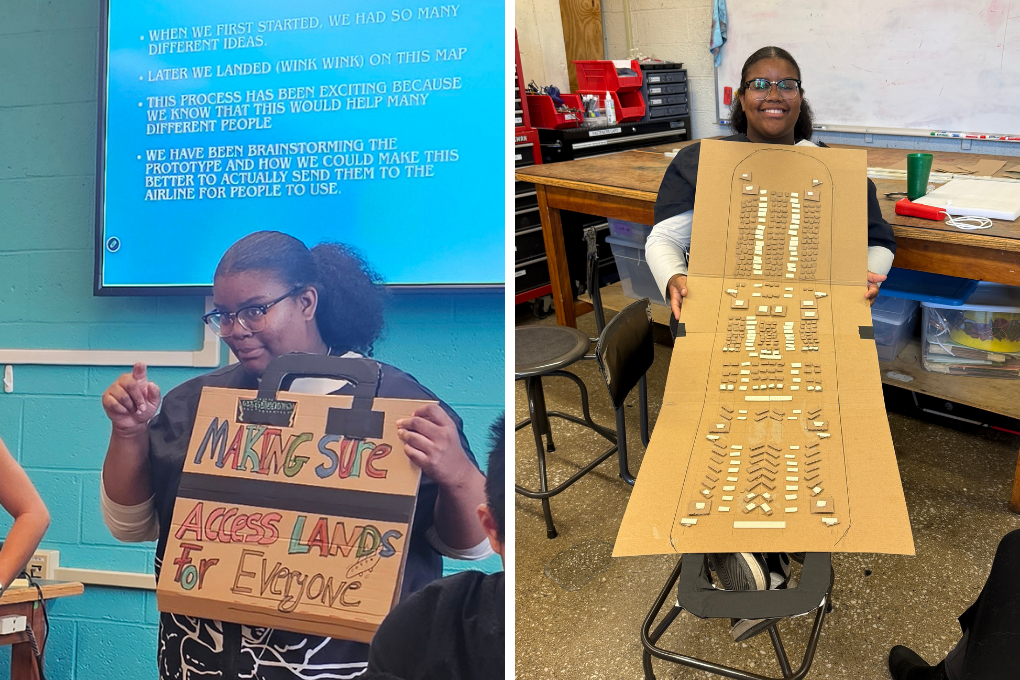
The most memorable collaboration of the three days emerged between Lucy, Harry, and their mentor, Jordina. Together, they designed the Aircraft Interior Recon (AIR) map: a tactile tool intended to help blind, deafblind, and nonverbal passengers navigate a commercial airplane cabin independently. Harry told the group “I have a huge interest in aviation, and I thought I want to make flying accessible for many people, not just for people who don't have disabilities.”
The team based the prototype on a specific aircraft, meticulously mapping out the business, premium economy, and economy seating arrangements, along with bathrooms and emergency exits. Together, they constructed a tactile, 3D model using cardboard, and a Perkins Brailler (a braille printer) to create braille labels indicating row numbers and letters, bathrooms, and emergency exits.
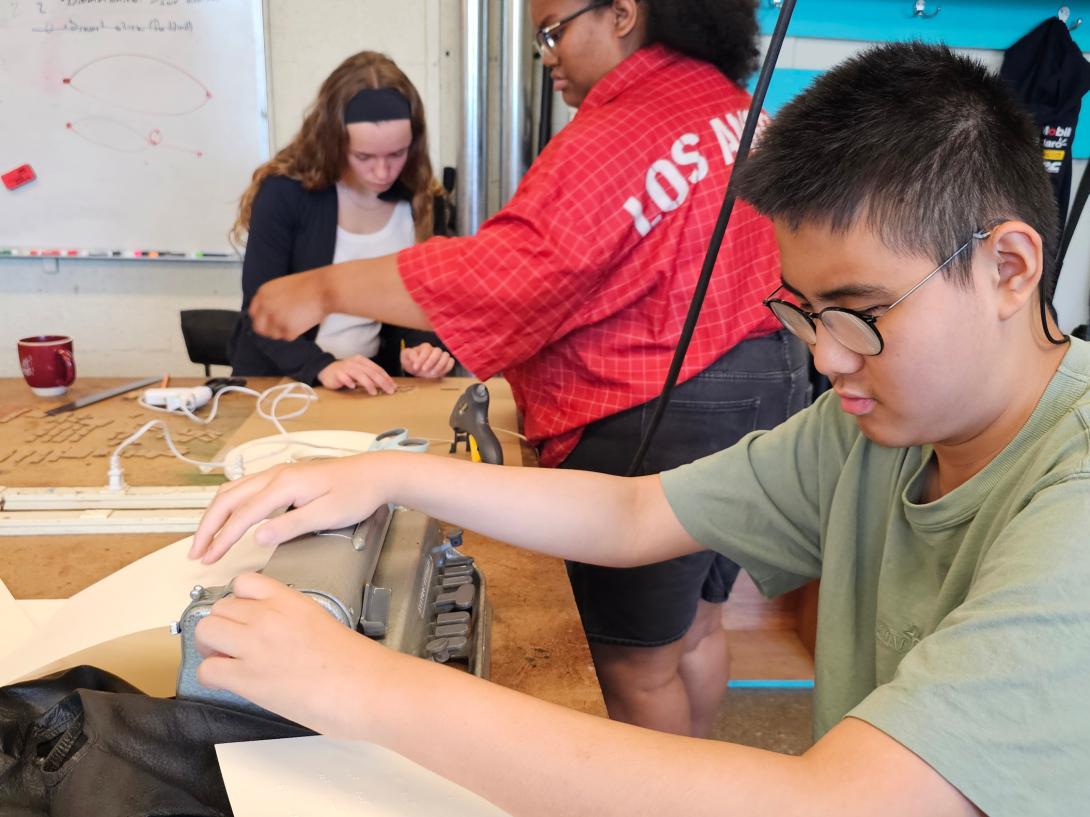
When someone suggested that a passenger could press a button and ask a flight attendant for help, Lucy pushed back. “This would be very beneficial for many people who want to travel around the world, because they have to rely on someone else. That shouldn't prevent them from being independent, being able to find their own way, and having their own access to travel the world.” She shared that while the tool might not be something she personally needs as a deaf traveler, she has deafblind friends, and she could see the gap clearly. Harry brought his own lived expertise in braille and tactile navigation. Together they were designing with direct community knowledge, for people they know and problems they’re familiar with.
For future iterations, they envision using 3D printing for greater accuracy and durability. They imagine a system where airlines provide these maps to passengers before boarding, a small logistical shift with potentially significant implications for traveler independence. Lucy, who heads to the Rochester Institute of Technology for college this fall, says she will “bring that idea into RIT with me. I plan on holding this with me into the future… for people to take it up.”
Student panel: making something out of nothing
In the closing panel, students reflected on what it felt like to build something real in such a compressed timeframe, and with people they had never met before. None of the students knew each other before the program, but that turned out to be a feature, not a bug. Drawing on different backgrounds and perspectives, teams pushed each other to take their initial "stupid ideas" - a category of idea celebrated in Edgerton hackathons for undeniable creativity - and refine them into something practical and presentable.
Time management was hard. Technical failures were frequent. But students pointed to something that made the difficulty worthwhile: connecting with their peers to creatively solve problems, despite their different modes of communication and varied backgrounds. “It was really nice to watch other people learn, and, you know, some people are learning new languages, and some people are learning sign language, and meeting people from other countries. It was very fun to socialize,” Lucy remarked. “It can be relaxing and supportive, and a good opportunity to learn from each other.”
Students also celebrated the mentors who learned alongside them rather than simply handing over answers. “I would say that a lot of mentoring is, like… mystery random projects.” mentor Maeve Macpherson ‘29 reflected. “I know a little bit of this, maybe I can help somebody with that, and then they show up, and they have a question about something I've never even heard of… it's a really good experience, and it helps me learn things for other projects.”
The workspace itself also played a role. The open, sometimes messy nature of the Student Project Lab made it easier to take risks. Lucy observed, “It's a messy room, but it's a vibe… It made me feel like it was okay to make mistakes, and try new things, and it didn't feel like I had to be perfect all the time.”
While the Edgerton Hackathon Challenge has concluded, summer at the Edgerton Center is just getting started. Over the coming weeks, Strobe Alley will host hundreds of students from near and far through programs like You GO Girl, a hands-on high school prep experience for rising ninth-graders, and Extreme Imaging, an introduction to the wonderful world of scientific imaging. Both have expanded to two sessions due to popular demand. In the mornings, the Makerspace is bustling with EDW students - including Carlos, who is returning for the full four-week program - and in the afternoons, the space is electrified by MIT’s Interphase EDGE. From engineering and electronics, to biology and optics, each Edgerton Center Outreach program represents the same core belief on display at the hackathon: that hands-on science belongs to everyone, and that the more widely it's shared, the better.
Photos by Jonathan Dietz, Amanda Gruhl Mayer, and Chris Mayer